Showing posts with label club. Show all posts
Showing posts with label club. Show all posts
04 November 2010
The African Roots of the Blues
University of the Arts literature professor and Blues guitarist Chris Devenny gave a talk/performance on the African roots of American Blues music on 27 October in the Large Auditorium. The DCCC Student History Club and Public Service and Social Sciences Division sponsored the event.


23 April 2010
The History of Cable Television
 The DCCC Student History Club invited DCCC alumnus Joseph DiJulio to speak about The History of Cable Television on 22 April.
Air Power in World War I

The DCCC Student History Club held a seminar on Air Power in World War I by Steven Suddaby, editor of French Strategic and Tactical Bombardment Forces of World War I on 9 March. Suddaby spoke about the history and development of aircraft, how aircraft changed war tactics, and how aircraft was a crucial part of the Allied victory in the Great War.
Suddaby presented images of kite balloons used to observe enemy lines miles away. He explained how balloons were tethered to the ground with ropes and sent Morse code through cable lines. Balloon crews directed the fire of artillery batteries on the ground.
Airplanes were originally used to take aerial photos of enemy territory. Suddaby explained how this set off the development of camouflage. Ground forces threw nets over railways and built wooden vehicles to fool enemy observation planes.
Suddaby talked about the development of aviation in ground and naval tactics. Naval observation aircraft helped Allied navies overcome the German submarine threat.
Suddaby concluded that aviation had a substantial impact on the outcome of World War I and dictated how armies and navies fought future wars.
24 January 2010
Haiti Relief


Kudos to the DCCC Student History Club for raising over $500 in four days for Haiti Relief!
13 November 2009
Math Makes History at DCCC
Recently, the DCCC Student History Club, Campus Life, the Public Service and Social Sciences Division, and the Math Division hosted speakers from the Battleship New Jersey. Two members of the Battleship New Jersey Museum and Memorial, Michael Flynn and Roger Willig, spoke about the battleship’s history and explained how algebra helped win WWII. The DCCC Student History Club was given a chance before the seminar to speak with them and more information about the speakers and the museum.
History Club: What is your job at the Battleship New Jersey?
Michael Flynn: I am the Director of Education at the museum. I have been there for two years. I am in charge of our on-board classes, which students of all ages enjoy, and the school outreach program, which brings the “ship” to the schools in presentations like today.
Roger Willig: I was a battleship tour guide for many years, and now I volunteer for the school outreach program. I was also a Professor of Math at Montgomery County Community College for twenty years.
History Club: Can you give us some interesting facts about the ship’s history?
Michael Flynn: The Battleship New Jersey was the longest battleship ever made. It had the largest guns and it is the most decorated American battleship with nineteen battle stars from WWII and Korea. It was the only battleship used in the Vietnam conflict. In 1991, the Battleship New Jersey was “mothballed” (decommissioned). The Battleship New Jersey was restored and, in 2001, opened as a museum and memorial.
History club: How did algebra help on the battleship?
Roger Willig: Algebra was used to figure out that they needed 660 pounds of gunpowder to fire the two-thousand-pound shells down the sixteen-inch gun barrels. The technology on the Battleship New Jersey was very advanced for its day. The guns on the battleship had sixteen different measurements that had to be taken before they were fired, like wind, humidity, ship speed, and direction. Some of the measurements included use of quadratic formulas.
History Club: Where can we get more information about tours and other events?
Michael Flynn: You can go to our website www.battleshipnewjersey.org to find the museum’s hours and prices. Information about our overnight visits, exciting special events, and how to become a member can be found there as well. The website also offers a detailed history of the Battleship New Jersey.
Interview by Kelly Brennan
16 March 2009
Civil War Medicine at DCCC
The DCCC Student History Club, Campus Life, and the Public Services and Social Sciences Division hosted a presentation on "Medical Treatment during the American Civil War" in the Large Auditorium on 25 February. Officers of the Student History Club conducted a brief interview with the presenters, Ian Semmler from the Civil War Museum of Philadelphia and Herb Kaufman from the Civil War Institute at Manor College. Professor Jeffrey LaMonica is offering a course on the American Civil War and Reconstruction at the main campus this semester.
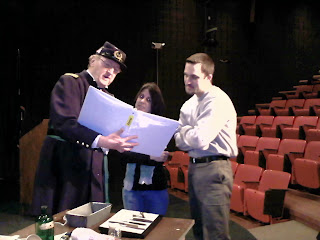 Student History Club Officers, Kelly Brennan and Sean Bray Interview Herb Kaufman
 Herb Kaufman Presents on Civil War Medicine
 Herb Kaufman Speaks with a Group of DCCC Students
Links
The Civil War Museum of Philadelphia
The Civil War Institute at Manor College
Where is the Civil War museum located?
Ian Semmler: It is actually not open currently, it will reopen in 2011.
How long has Herb Kaufman been doing these presentations?
Semmler: He has been teaching and doing civil war presentations for about thirty years.
Are most of your presentations done at colleges and universities?
Semmler: Well actually we go to a good number of elementary schools as well. In fact, one of the programs I am working on is bringing this presentation to schools in the city of Philadelphia that can't really afford to go on field trips to the museum. Untill we reopen in 2011, these are the kind of educational programs we will be working on.
What kind of education or training qualified a person to be a doctor?
Herb Kaufman: There was no training for doctors; all you needed was enough money to attend lectures. You gave your money to the professor, and went to his lectures for nine months, and then you would do this again the following year. After eighteen months of listening, you called yourself a doctor and went out and practiced on patients. That is why they call it practicing medicine. Surgeons learned by watching other surgeons and by reading European books. Sometimes they would stand over the patients during surgery, and have an assistant hold the book and would actually be reading and referencing the diagrams while performing the surgery.
How did they sterilize the tools and themselves before surgery?
Kaufman: They didn’t. They did not know what germs were. They would wipe a tool off with a dirty, bloody rag and move on to the next person. They also wore their uniform or street clothes during surgery. Some doctors would wear an apron so it would not ruin their uniform.
What kind of uniform did a doctor in the military wear?
Kaufman: The same as everyone else, except he had a green sash. The green came from the flag, a hospital tent would have a flag with a green “H” on it, this was before the Red Cross had come around. The problem with a doctor wearing the same uniform as everyone else is that they were shot at also.
How did a soldier seek treatment if wounded?
Kaufman: During the civil war a gentleman by the name of John Leatherman came up with a system that is still used on the modern battlefield today. There were three parts, first a field station. This was pretty much on the front line and they would triage you. They would assess the soldier and if needed, they would be sent to the division hospital. The division hospital was away from the action but still close to the battlefield, here is where they would set bones or perform surgery. From there you would go to the general hospital to recuperate; this was far away from the battlefield.
Did they really amputate limbs without anesthesia like in the movies?
Kaufman: No, they did not. That is a Hollywood myth, no one was biting bullets. All medics had ether or chloroform with them.
What did a medic carry on him?
Kaufman: While traveling he would carry a smaller set of tools and his drugs.
What was the main tool the doctors used?
Kaufman: Their finger. Remember they did not have a concept of germs. They used their fingers to probe wounds and try to find the bullets or shrapnel inside. When Lincoln was shot several different doctors stuck their fingers inside of his head trying to find out what was wrong and where the bullet had went.
What did they use for pain?
Kaufman: Large amounts of drugs like opium and alcohol. Of course they became addicted to it but they did not understand that either. It wasn’t wrong back then to be addicted to drugs and alcohol, they called it soldiers’ disease.
Was amputation really necessary?
Kaufman: When a bullet would hit a bone in your arm or leg it would shatter it, or sometimes the bullet did not exit; this can cause serious infection and you would die. If they amputated the limb it would get rid of the problem and a person would have a much higher rate of survival.
 Student History Club Officers, Kelly Brennan and Sean Bray Interview Herb Kaufman
 Herb Kaufman Presents on Civil War Medicine
 Herb Kaufman Speaks with a Group of DCCC Students
Links
The Civil War Museum of Philadelphia
The Civil War Institute at Manor College
29 December 2008
DCCC Student History Club Hosts Vikings
Our history faculty started a new Student History Club in Fall 2008. The club sponsored a presentation by the Leif Ericson Viking Ship Living History Group in the large auditorium on 24 November.
 A Viking Speaks at DCCC
 Our Students Speak with Vikings
 A Viking Speaks at DCCC
 Our Students Speak with Vikings
Subscribe to:
Posts (Atom)
